report from apr 29 2025: today a large insect flew into my room

generally insects are quite small but in comparison to most insects this one was a giant. and due to its enormous size (it would take something a shade smaller than a pingpong ball to encase him) it suffered from all sorts of problems smaller insects would never experience.

for instance, it took a great deal of space for it to be able to flap his wings hard enough to lug its hefty body off any surface. i watched it crawl back and forth in the space between a paper box with a bottle of ink in it and the small ledge of my window that allows fingers to grasp and pull upwards, fruitlessly flapping and pacing frustratedly, occasionally taking breaks.

finally it crawled to the outside of the books next to the box and took off. it wobbled a bit upon takeoff, and who wouldn’t, carrying that dark glistening mass, whose upper third was covered with a thick pale yellow fur with a faded black dot on it, on those thinner than paper, already too large yet proportionally quite small, almost translucent wings?

it maneuvered itself and fell onto the pane of a different window, finding a cold slippery surface upon which its little legs could not grab ahold of anything, looking exactly the color of open air, blue sky — looking just like freedom.

it was at this point i found the occasion was ripe to slowly place my recently emptied glass of orange juice over its head, and slide a piece of construction paper beneath its dainty legs.

finally i set it out on the window ledge and it took off, floating into the spring breeze.

杀年猪

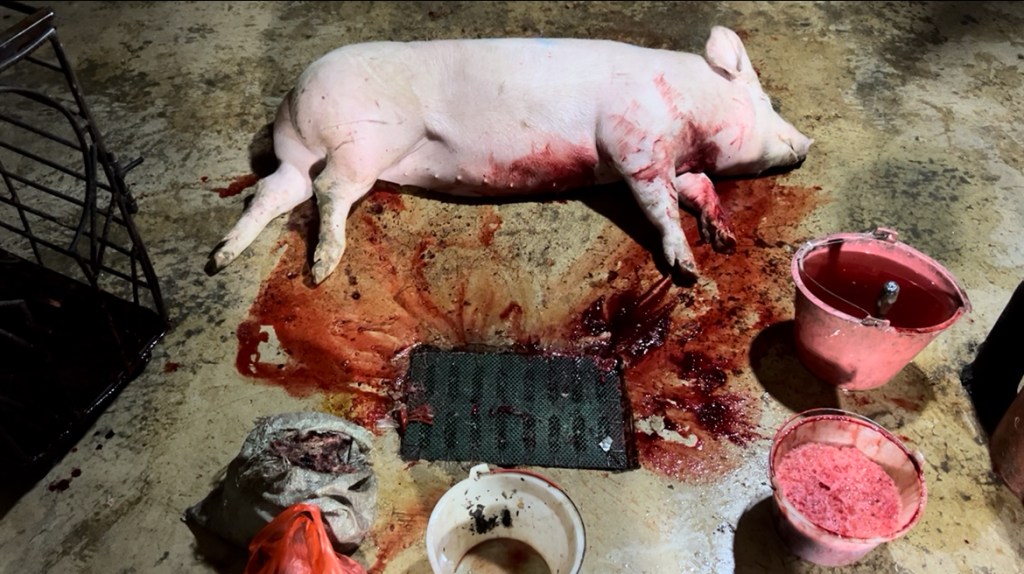
the first time i saw a pig killed the “old fashioned way,” which was not old at all, for it used a cage that did the work of three men by constraining the pig and it allowed a man to slaughter a pig on his own, my heart quailed and tears gathered in my eyes as i watched it grunt with increasing frequency as it was wheeled out of the pen and into the center of the concrete floor, grunts which turned to squeals which grew louder and louder as it was sharply hooked under the chin, head yanked out a hole at the front of its cage, feet slipping on the watered down wooden boards, and a long blade inserted in its throat.

another pig killing was happening somewhere down the road, and its screams were faintly echoed by those of another.

the orgasmic nature of blood letting was already familiar to me as i had experienced this killing quail. but different now with its large head still on, its eyes rolled back, and its quivering body not in my hands but pressed against the black metal of the cage. with each softening grunt, another spurt of blood gushed from its throat into an outstretched bucket, which was swilled around to keep from coagulating.

my host talked over its screams, telling me this and that, perhaps trying to lessen the intensity of the moment. to the best of my ability i blocked him out and focused on the dying creature, nodding politely.

a silent prayer as its spirit faded. with a final shudder, it fell against the ribs of its cage. in a perfunctory manner, the door was kicked open and the pig slipped out onto the concrete ground, slightly tilted towards a large drain.

for the first twenty minutes, and with surprising tenderness, hot water is poured all over its body, which twitched and quivered on contact. knives were taken out, its body scraped from head to toe, clearing its bristles.

then, it was heaved onto a rack and cut from head to toe. first, its tongue was removed through the opened throat. kept in a bucket for later. then the large intestines are pulled out and soaked. saved for later. out here they are the most expensive part of the pig. the heart, the lungs. the bladder, liver, kidneys. i can only assume. they take their places, some resembling dark flowers, others resembling pale balloons, some on the floor, some in buckets. a clot of coagulated blood drifts towards the drain. the slaughterer kicked it along.

the head chopped, weighed, put in a bucket. the body, halved, on two different tables. my host tells me the front part is the tastiest because it moves more.

the heart still beats, an hour after the killing, long after it’s been cleaved in half.

***

the second pig they kill “just for me.” the slaughterer is feeling tired, so his father, also a local pig slaughterer by trade, takes his place. he and his wife wrestle another pig into the cage. again, the wakened pigs squeal and huddle about. this pig is much more vocal than the last, and perhaps because they didn’t rewater the floorboards, it seemed as if the pig withheld its life to its last breath, lip snarled and foot pushing its body back away from the cage’s head opening until finally, it lost its strength. again, the cage door kicked open, the body slumped out. my host calls me away soon after the initial hot water pouring, which caused this pig to curve its body and raise its head. the pigs in the pen, now down to seven, are again cuddled up on the concrete, asleep.

***

the third pig whose death i witnessed was killed on the occasion of the passing of an old woman in a neighboring village. the pig lay quietly in its cage, with boards leaning up against all sides, so quietly i failed to notice it for quite some time, even though it was right in front of me. also white, but much fatter than the other two, with floppy ears. presumably a few more generations removed than the previous ones from its lean white foreign fathers.

it’s time. the slaughterer calls three other men to help, two of whom don coverups. one of them opens the door and pulls it out by the tail. the screaming begins, but its dainty trotters don’t gain a foothold on the floor. the three men drag the pig, who would surely be putting up more of a fight if a hook wasn’t in its mouth, slaughterer pulling on it without mercy or hesitation. it totters on her trotters squealing all the way, partially drowned out by the blaring music. the men heave her onto a low bench and cross its hind legs, holding them in place. it does not resist, its free leg does not thrash, it is only screaming. i am prepared, by now, for the deep throat cut with a single jab of a knife, and heightening of the scream, the bloodletting coordinated with final moans, and the swirling of the bucket. i am not prepared for the firecrackers that drown out the screams, nor am i prepared for the way the slaughterer roughly tosses the body in an arc over the bench and onto the floor on the other side, where it lands with a jiggle and gasps three more times, each time emitting a steamy cloud of warm air.

the men walk away dusting off trousers and dipping hands in a bucket of water to clean them, everything but their stoic faces emitting an aura of having done a dirty thing.

***

on my way home, i reflected on the bright red that adorned every chinese establishment across the world at this time of year, to bring good fortune. the bright red that is mirrored, for a moment, in freshly spilled blood. this time of year that was for most people their annual taste of meat.

and i thought about the difference between innocence and renewal. the tradition of cleansing the rages and disappointments of the past by covering doors trees and lights in red, setting fireworks and eating pigs to send off the old and usher in the new year, innocent as a newborn babe awash in blood.

accompaniment

the day after i cooked the two quail i killed
my cat trotted into the living room
with a dying baby rabbit in her lizard like maw.
the small thing lay there
occasionally gasping for air.

my cat had never killed before
(like i before the quail)
& for awhile i thought it merely in shock
& placed it in a box with a bowl of water.

later that day when i was taking out the trash
i saw she had left another one at the back door.
this one was fully motionless
also with thin skin bloodily pierced on the hind leg
and i laid it next to the first which had long gone still.

unlike the quail i killed
whose orgasmically spasming bodies
quivered & yearned in my hands
red flesh reaching from opening
toward severed sleeping head;

who smelled & tasted beautiful
tender yet textured,
after steeping cold in salt water and five spiced buttermilk
then hot in an onion tomato stew cooked over a campfire
delicate bones welcoming the tongue amidst crunchy bread
whose little feet continue to keep each other company
on the window sill of the woman who raised them from their egg

no, within days the bunnies had gone putrid
smelling similar to trash
& they lay belly to back in the box
until i buried them at the roots of a tree by the lake
their small sleeping bodies
tumbling into the mouth of the dirt.

day 2 in 荣昌

f shows up at 9 am sharp the next morning. i wolf down my breakfast and get into his car. we drive into the green hills. we’re going to visit some peasants.*1

we pull up to the county bureau office. a pickup truck full of small piglets pulls up to us, squirming up against each other in the wicker crate. no need to look there, he says dismissively, those aren’t rongchang pigs.

we get into the car of a soft spoken man who is an official at the local agricultural bureau. he drives us up a dirt road to a brick house. a young dog and a rooster trot in front of the door, tattered pieces of red paper hanging on either side of the opening.

we put on white coveralls, much like the infamous 大白 enforcers of china’s zero-covid policy, with blue plastic shoe covers to boot. we walk past the abandoned brick house up a hill to a second one.

an old man with tanned farmer-health glow walks out, along with presumably his wife—a woman who never says anything, but hovers and smiles. piglets circle their feet, and a cat paws at them from a stool in front of their front door. the piglets are 20 days old. within a month they’ll be too big to allow outside of the pen.

the pens are made of concrete and attached to the brick house. i walk in and see enclosed in a small concrete cell a big pig, the mother of these piglets running amok.

my feeling of intense live-pig deprivation yet unabated, i dwell as long as i can in the company of the calm mother pig, ears covering her face, chewing in the dim light filtering through the window.

too soon, f calls me outside for the interview.

first he tells the official who came with us to grab two piglets so i can take a picture with them, a piglet in each arm. he grabs one by its little ankle and it screams bloody murder. he grabs both of its hind trotters and it immediately goes quiet, docile “as a lamb.” he hands me the piglet, which immediately begins squirming and squealing, until i manage to fit its two hind trotters into a hand. one is enough, i say. no need to grab another.

f takes a picture.

i ask some simple questions, like how the pigs are fed, how long they’re kept, and the age of the piglets running around our feet. f interrupts with answers about the procurement system, about what peasants feed their pigs, about how each pig is insured by the local government.

before long, he says it’s time to go. we leave our white zip ups and shoe covers. we drive to another house. we put on a different set of white coveralls and blue shoe covers. here only a woman is home. she’s married in from a different village, and hadn’t raised pigs before.

it’s a lot of work, she says. pigs have a lot of needs. nobody wants to do it. but we do it to make a little money.

i ask her some more questions and f keeps interrupting with answers. soon it’s time to leave for a lunch party he has to make. an old classmate is having a 90th birthday celebration for his father, and since i’m in his charge, i’m going.

as we drive back, we make conversation about how he became a vet, how his parents were farmers, how they’ve passed. his daughter lives in chengdu.

rongchang pigs are more famous than rongchang people, he says, without a hint of bitterness.

we go to lunch. at each threshold — the main door, the opening of the elevator, and the entrance to the dining hall, f is greeted by a smiling familiar holding out a cigarette, like a chinese fist bump. he walks down the hall into the dining room holding one cigarette and smoking another. we sit down at a round table. he introduces me as a phd from peking university. hello, zhang phd, everyone greets me with a note of deference. my neighbor inquires about my research, picking at watermelon in front of the meat dishes piled three layers high on the lazy susan in front of us. so wasteful, f’s wife clucks next to me. she’s a language teacher at a local school.

after lunch, i’m feeling drowsy from the noontime feast. i can only imagine my compatriots feel the same way. but chinese tours don’t rest. we go to the canal, along which a carved mural of the history of pig production sits. a huge bust of the rongchang pig, along with other breeds, like the duroc, landrace, and yorkshire, sit on a neighboring plaza square.

after milling around and looking at the mural carved by local art students we go on search for pig buddha. c, who has joined us after lunch, remembers praying to them as a child. we drive to a temple, circling around the figurines. no pig buddha. a monk pokes his head out and we explain what we’re looking for. it’s over there, he gestures. we circle around some more, not finding it. finally an old lady pokes her head out. she comes up to my shoulder, about. pig buddha! she exclaims. she knows where it is. she walks over to the room full of small figurines we’d already been in and there in the very corner was a small stone pig with a red ribbon tied on it, ensconced in spider webs.

unsatisfied (clearly nobody has worshipped this pig in a long time) we drive into another farmer’s home, straight into their backyard, where a small slab of concrete sits amidst the soil, and two dogs stand next to our car, barking.

we get out. f explains we’re looking for their pig buddha. c knows there’s one out here, he remembers from his days playing in the mountains as a kid. the farmers motion to their backyard.

we wade through tall grass. walk through a stone archway, down cracked stairs. reach a shaded forest trail, along the side of which two moss-covered stone pigs sit under white plastic, the roof having long caved in. c removes the plastic covering, dusts off the rotting leaves that cover the stone with his hands and a stick. we have a prayerful moment. the mosquitos have painful bites. c covers the pigs up again with white plastic and we go back up the stairs.

we drive to one more, again walking into a farmer’s yard and into the mountains beyond. f stays behind this time, playing music loudly from his phone. we clamber up a steep slope into a small concrete house filled with “buddhas.” sitting demurely on a sow feeding her piglets by a corner on the floor is 送子娘娘 — a goddess of fertility. one hand on her stomach and another in her lap.

on our way back into town we drive through 西南大学, f’s alma mater. he points out the animal testing stations, the old dorms, walls where his name is. students milling around us.

finally it’s time for dinner. we drop f’s car off and take a didi. everyone is tired. we sit apart and scroll on our phones. soon we are called to go upstairs, and seat ourselves in a private room. the guests haven’t arrived yet. i make small talk with c. fan sits in a corner smoking and scrolling.

before our guests arrive, a waiter walks in and places two plates of bloody baby pig dicks on either side of the simmering chili oil pot.

  1. chinese farmers are sometimes called farmers, sometimes called peasants. the thing is, there’s a titter about peasants because it’s such a “feudal” term and we’re supposedly past that. in chinese the name for “peasant” never changed, so it’s academic convention to say chinese peasants. so i use them interchangeably here. ↩︎

day one in 荣昌

there’s often a small army of youngish men who stand outside the train station in small towns in china. 荣昌, a sort of rural/suburban/urban township west of chongqing, is no different. the first thing i do stepping out of the train station is to disregard my grandma’s warning and take one up on his offer. he takes both me and a mother with her child. i notice the row of 黑车 (“black cars,” to denote how they aren’t registered with any taxi or rideshare service), are all white. i tell him to take me to the ruier hotel.

as we pull up, he says — this is the best hotel in town. you must come from a good 单位。 ha, i say i guess so. i’m a graduate student though so it’s my own money. (besides, it was 380 RMB a night — which comes out to about 50 USD). he looks shocked. well then they sure scammed you! we pull up into an intimidating skyscraper. as i walk by i see a “PARTY KTV” on the side of the building, doorway flanked by two roman soldier type busts. a tour bus sits in the driveway, “Golden Dragon”—the typescript of the D is that of Disneyland’s D, and the G a sort of symmetrical approximation.

I walk into the hotel with a ceiling at least 6 stories high, large chandelier hanging and golden decor from floor to ceiling. the front desk is as wide as a tennis court but manned by only one person. i check into my room on the 19th floor.

as soon as i put my bags down, f, my contact in the area, texts me on wechat. 下车了吗?did you get off the train? i just checked in, i said. send me your location, he texts, twice. i do. come over, he says, sending the location of the agricultural bureau skyscraper, about 500 meters north.

i hurriedly change, regather my things, and walk over across the ginormous four-lane roundabout that also includes difficult to decipher traffic lights. it’s a cloudy, humid day — the standard for this part of the country, this time of year. later i’m told they often only get 90 days of sunshine in the year, hence the need to consume copious amounts of chili peppers. the wet just-rained smell hanging all about is delicious.

i walk into the skyscraper trying not to slip on the marble(-like) steps. there are two small elevators servicing the entire 20 story building, and it’s about time to get off work. there’s a crowd waiting for the elevators, and across from them, a mural depicting a man in a straw hat and white shirt (a farmer type) sitting next to a man in a short-sleeve polo holding a computer smiling and talking. written above them are the words: 中国要强,农业必须强; 中国要美,农村必须美;中国要富,农民必须富。if china wants to be strong, agriculture must be strong; if china wants to be beautiful, the villages must be beautiful; if china wants to be rich, the peasants must be rich.

finally i squeeze myself into an elevator. it smells like smoke. i listen to the post work banter. i walk out into a hallway so dark i think i must be in the wrong place. but there’s a bald man with dark slanted eyebrows and a belly walking about with an air of authority and expectation. upon seeing me, he says you must be…. 小张, i say. we shake hands.

he shows me to the communications department, introduces me to 陈科长。 chen is in charge of the rongchang pig propaganda publications. but it takes me a long time to figure this out. he’s printed out two random pages about the early history of the rongchang pig, which i glance over. i begin trying to explain my interest in rongchang pigs. they were some of the first pigs identified by US-trained agricultural reformers during the 1920’s during the first phase of Rockefeller-sponsored “Green Revolution,” during which Americans tried to subvert the rise of global Communism by spreading agricultural technology. The goal at the time was to rid the world of hunger, which was, back then, commonly understood as the root source of Communism. I tell him I’m interested in how the breed went from an ‘indigenous’ 本土猪 to a scientifically bred piece of intellectual property. He keeps giving me books and telling me my questions are too broad.

F walks in, asks how it’s going. i don’t know how to talk to her, chen says, hands splayed. every word out of her mouth makes it clear that she’s an industry outsider. i gave her some materials, she can go home and digest and come back with questions.

next f escorts me to a neighboring office and asks x 科长 to explain their breed protection system. she asks if i can understand sichuanese. I say, just go for it, and if i don’t understand i’ll let you know. she begins to explain the various elements of their breed protection system.

after hearing more about my project, she says i should go to the sichuan academy of sciences, since the breeding focus of my project has to do with the research and development side of pigs. when she brought it up to f, he brushes her off. she looks at me sympathetically and gives a shrug.

later she learns from f that i’m not a chinese citizen. you’re an american? she looks visibly shocked. she starts shaking her head. well in that case i really can’t give you any more. no wonder he wouldn’t take you to the academy of science. i ask her a bit more — like what of the materials she gave me shouldn’t i publish. but she won’t even look at me, she just stares at her screen steadily. i think, she’s not sure of what exactly to be worried about, either. we fall into silence.

you wanna see my 实验室? fan says, coming by again. sure, i say. we walk down a couple dark flights of stairs. he shows me various dark rooms full of blood samples. previously i had met an american vet who worked in beijing. he was one of the few left who still looked directly at dissected pig bits. i asked if there were any around. fan looks at me, somewhat annoyed. no, you can tell everything from blood samples. he motions to the machines. these are all top of the line, he says. very expensive. i nod.

we leave the examination rooms and he sits me down in his office. there are three young women also working at computers there. they’re giggling and talking about how much money he just spent on hiring a nanny for his grandchild. just hire me, one of them says. soon it’s time for them to leave. f keeps inviting people to have dinner with us. it seems to me everyone he asks can’t make it. soon after the girls leave, f gets up.

wait here for a bit, he says, leaving the office. i wonder if he’s doing so just to escape the awkwardness. i scroll on instagram, little bytes of english sound providing a modicum of comfort. i’m drained from pretending to know what’s happening while feeling like an alien.

15 minutes later he pops back in, says let’s go. as we wait for the elevator he puffs on a cigarette. can you eat spicy food? he asks. i say well…i can eat a little but maybe not by sichuanese standards. he’s like sichuanese food? sichuanese food isn’t spicy. i say well in that case i definitely can’t. i get a grunt in return. we walk into the elevator. he keeps smoking.

in front of the entrance to the building we are joined by a bright faced man and they greet each other warmly, making small talk, chinese style. which mostly consists of making mundane observations in a friendly tone. shit like “oh, you’re here.” “oh, you’re leaving.” “okay, see you tomorrow.” as for what they actually talk about i can’t say — i’m zoning out hard and he doesn’t introduce me. they fall quiet and we stand 3 feet apart from each other, fingering our phones.

i ask, mostly to break the silence — so, how do you know x (the professor at the 农业展览馆 who linked me to fan)? he says — i don’t. he knew my old teacher who told me to take you on. he exchanges a glance with his colleague/friend. i think: neither of them wants to be here.

he lights up when he sees a car pull up. a man is driving, a woman in the passenger’s seat. 好久没见到美女了!he exclaims. it’s been a long time since i saw pretty-woman! pretty-woman is how anyone addresses a woman who can’t be called a child, an older sister, an aunt, or a grandma. i get called this by wait staff the most often, but i guess it can be used for the wife of a colleague-friend as well. it makes me think of how later, upon seeing my rongchang pig book, my grandma told me her mom’s name was also rongchang, given by her husband. because back then, women weren’t given names.

when we pull up to the restaurant there’s already three or four men seated at a table, all in dark jackets of various formality. one walks over, buys two bottles of baijiu.

soon after, a large flat dish full of chilis pickled veggies and meat bits arrives at the table, taking up almost 1/3rd of the space. now this, this you can only get in rongchang, f tells me. there’s a titter about. it’s from the first cut of the pig, another man tells me, corner of his mouth curled in a way where i can tell there’s something not being said.

what’s the first cut, here? i motion to my own neck and chest area, imagining the first cut of a pig’s slaughter. the men kind of shift in their chairs grinning and not looking at each other. let her explain it to you, fan says, nodding to the pretty-woman, seated to my left. but before she responds their words sink in. the first cut i realize…is the castration of the piglet. we’re eating baby pig dicks!

oh i get it, i say. everyone looks at me. you sure?? they ask. yes, i get it, i repeat emphatically. they chortle and tell me to eat.

these men, i harrumph to myself. luckily i’ve been lightly food hazed by chinese people my whole life — enough to trust i can swallow basically anything on a plate, especially if it’s spicy. i take a bite. the little bits are slippery, crunchy, kind of like fat but not oily. it’s honestly quite delicious. as we all begin eating, i glance over. you don’t eat these? i ask the woman next to me. she shakes her head.

they’re called 逾西肾宝—western chongqing kidney treasures (but like not the modern anatomical definition of kidney but a traditional, much broader medical definition that included reproductive equipment).

don’t worry, f says. i’ve sent you the terms of wechat.

this is important education in pig culture, he says. i heartily agree. encouraged by my interest, the lessons begin pouring in.

around the table, they begin sinking comfortably into their positions, explaining the culture to me. telling me to fill my cup to the top, and upon toasting someone, emptying it completely. you have to see the bottom, they insist.

the man sitting to my right is a 村长—basically the overseer of an actual village. at first, when the men were all trading remarks said like announcements and met with laughter, he just laughed along, hands folded to himself. but as the meal went along, he began telling me all sorts of things. like how the 鳝鱼 we were eating were poked directly out of the soil on the crop fields. about how i had to come back in december/january to taste the soup made from a freshly slaughtered pig. come again 腊月, the 12th month, where every peasant family kills a pig, he kept saying. 特别香,he promises. occasionally, our conversation is interrupted by another man telling me that i was speaking to the most foundational level of the officials, the one whose work was the hardest — something that was already obvious to me by the thickness of his hands. but each time, he would look down smiling demurely, and i would nod, face full of new understanding.

at the end of the meal, the waitress brings out a big platter of noodles, and they pour all the babypigdick sauce onto it, as well as the leftover sauces from a couple other dishes, mixing it thoroughly. another “traditional rongchang only dish,” of course. i had a bowl. it was, again, delicious.
a day with mr. huo (pt. 2)

we are joined by his cousin and someone he calls his older brother but i later learn is actually the son of his dad’s older brother, and a man married to his older sister who is also the village party secretary. we meet him at the small but stylish party headquarters for the village, and after introducing us, mr. huo informs him that i’m from the US, i have no idea what village secretary means. i don’t tell him i’m not that familiar with the bureaucratic structure of my local governing body in the US either.

we go to a place for 农家饭 — a farmer family’s restaurant. there’s salted pork hanging from the rafters outside. the dishware comes wrapped in plastic. they try to make me order but i decline. they try to figure out if i eat spicy or sweet, i say salty is just fine. his cousin and the party secretary start smoking. the secretary offers me a smoke, looking vaguely surprised when i refuse. they order a couple sodas, his cousin gets a beer. they order chicken soup, raw veggies with soybean dipping sauce, cucumbers with garlic and peanut sauce, egg custard steamed with tofu and chicken soup, cold braised pork with a soy and garlic dipping sauce. some fried tofu dish i can’t place. purple rice.

they talk mostly about things i don’t understand, something to do with expanding property and investing money and how to discuss problems with so-and-so. sometimes there’s a bit of tension, other times nostalgia. they talk about how good rice used to taste before artificial fertilizer took over, how good tofu skins used to taste. they tell me to eat more, men put meat on my plate chomping on raw veggies themselves, drinking soup straight from the communal pot with their spoons. mr. huo pays. after we finish and pack up the leftover chicken soup we move out into the main room. the men smoke a bit more and eat a couple slices of watermelon before heading out. ash trays doubling as a place to spit seeds.

it’s too hot to go into the mountains, mr. huo says. come, you can see what a village house is like. we pull into a row of small white one-story houses, lined up closely, painted with bright colors and depictions of trees and flowers. craggy ancient mountains speckled with greenery in the distance. earlier his cousin told me that before the mountains were all bare, their greenery used for kindling.

we walk into his home, which is also spotlessly white on the inside, brightly decorated with flowers and family portraits. there’s plants and a fish tank. a bird chirping outside in a cage. i tell him his place is lovely. he says his wife does most of it, though he’s pulled out a swiffer within a couple minutes of us getting in the house. (his wife and son are currently staying in chengde, the city. his son is 16. he’s 39). his cousin brings in a birds nest. apparently an old farmer had found it fallen off a tree after some strong winds earlier in the week and given it to them. the baby birds, no more than a couple weeks old, had been with us in the car all along. mr. huo fed the five small black bids some whole-grain mustard looking substance from a little ceramic jar with a small wooden spoon.

i was tired, both from not sleeping well the night before and from fronting like i knew what was happening for half of a very hot day. i pull out my computer to do a little work. mr. huo brings out cherries, a yogurt drink i didn’t finish. soon i fell asleep on the couch. he kept very quiet, whispering his voice messages, feeding the birds. i slept for two hours, surprisingly soundly.

when i woke up, the day had cooled. it was about 4. come, he said, let’s go into the mountains. i’ll show you a live dragon. we pass by the farm and i dawdle by the pigs again. i tell him i’ll come back and sit a whole day in the pen one day. write the best parts of my dissertation. sure, he says.

we drive up further up the mountain to an observation deck. along the road we bump into all sorts of townspeople, and every time he rolls down his window, makes a little conversation. i think it’s nice. i tell him i barely knew my neighbors. he says he has make conversation or else they’ll start gossiping about how arrogant he’s become. he says frequently how he doesn’t like to leave his house much anymore. even so, it seems to me the whole town is constantly blowing up his phone.

we walk up to the observation deck. originally it was supposed to be built so one could walk to the top from his house but they ran out of money. they did, however, include a QR code virtual reality installation where one could scan it, point a smartphone at the mountains, and see a golden dragon swirling around. kangxi or qianlong once heard tell of someone seeing a dragon here, he told me. i think.

we look out at the peaks in the distance, covered by a thicket of greenery. mr. huo tells me they are so well-guarded for fire protection reasons it’s hard to walk into the forests anymore. when he was a kid they would run up into the mountains collecting medicinal herbs and scorpions to sell for ice cream money.

we head back down the mountain. he’s been on his phone this entire time, taking calls, returning voice messages. our conversations are splintered into little bits as he pauses between his comms to tell me this or that little fact. i’m happy to have less silence to fill anyhow, this late in the day of continuous conversation with someone i’d never met. as we walk down the mountain a young fella with a girl in the passenger’s seat and a dog in her lap pulls up our slope. oh he really came, mr. huo said. they roll down the window, the dog yapping and sniffing at mr. huo. they offer us apricots picked from the trees down the mountain. mr. huo has been telling me about these apricots all day, saying how he’s going to send me home with a bag. they are delicious.

we all go down the mountain a bit and an older shirtless man with a fanny pack, evidently the caretaker of this small apricot orchard, watches as mr. huo tells the kid to pick some apricots. nobody has a bag for them. mr. huo pulls out a brown paper bag full of beef jerky. he feeds it to the dog. the kid says what a waste! you eat it then, mr. huo says. it’s too tough for my teeth.

he gives the bag to the kid who scrambles up into a tree and begins picking apricots. you should get a QR code for these trees, mr. huo quips to the orchard watcher. i’ll just come and pick up two pig skins from you, the orchard watcher says. just two?? mr. huo says, incredulous. save a little face for me won’t you? the riffing continues, swerves into a conversation about what’s “black.” the gist is he’s trying to say the guy should take more than two pig skins. this isn’t about money, this is about 情, he says. there’s no white or black here. it’s about feeling.

he’s used this term with me before, to describe the feeling amongst people in his town. not the feeling between husband and wife, he clarified at the time. the feeling amongst kinfolk. everyone has the same family name here, he said as a matter of explanation.

on our way back to the city we pass a line of ladies selling fruits and eggs by the street. seeing us slow they immediately began swarming the car holding up their cucumbers, salted duck eggs, apricots, plums. he bought me a bag of each. except for the apricots. i kept saying i couldn’t take this all home with me. he said it’s not a problem you’re just getting on the train. after stopping for a dinner of 烧烤 — grilled peppers, eggplants, raw oysters, lamb skewers, 小龙虾 (little dragon shrimp?), more i can’t remember through the haze of meat and beer — he gets a young kid (代驾)to drop us off at the station, driving like a maniac on a mission to try to get me on time. i still miss my train (or technically not the train itself but the cutoff for checking tickets), partially because one of the thin plastic bags full of fruits and eggs ripped apart at security check. anyways, i changed my ticket to the next train departing half an hour later, lugging the fruit home. and indeed the fruit tasted much better — sweeter, juicier, more like themselves — than all the extravagantly priced fruits i had ever bought in beijing, less than an hour’s train ride away.

a day with mr. huo (pt. 1)

we bump into each other at the parking lot of the 承德 train station. he’s in a black polo shirt and black pants. we walk to his car making light conversation. the engine’s still running. his older cousin is sitting in the back. “i had him help me with something,” mr. huo says.

we begin the winding drive to 孟家庄村, the small village he’s from. he’s been living there since the pandemic began in 2019, and started a small (~1,000 head) pig farm as part of a local government initiative to support small-scale agriculture. the grand scheme is to begin providing piglets to local farmers with a little extra labor at home, have them raise the pigs, and return them when they’re ready to go to market. but so far, business has been lagging, and they would be losing money if it weren’t for government support.

mr. huo grumbles about how it’s hard to develop at home. people develop attitudes about anyone who tries to do anything different, he says. it’s much easier to go develop in a place you’re not from.

we pull into the county judicial office—mr. huo has some forms to sign. i talk about covid in the US and China with his cousin, who has an abiding interest in american society. he thinks covid was handled better in the US, more democratically, because the chinese economy suffered too much. it was barely handled, i reply. he laments the state of affairs in China, describing the left behind rural areas. he tells me i’m in one of the poorest areas in the country. people who work for the local government regularly miss paychecks, he informs me. it’s hard to believe looking around at the beautiful surroundings. the local village and government buildings are freshly painted and designed, often by Tsinghua students.

after about half an hour, mr. huo comes back out, apologizing for the wait. we drive through more mountainous winding roads, sometimes made of dirt, sometimes rough gravelly concrete, and sometimes smooth paved roads. many of the roads aren’t wider than a lane but we don’t run into anyone.

we pull up onto a slope where the road ended surrounded by blue boards with black pigs painted all over them. we step out of the car, immediately greeted by the earthy smell, truly not unpleasant, but recognizable as shit. i could hear shuffling snuffling, snorting, and the occasional squeal.

i walk up to the concrete wall, about shoulder height, and gaze over, heart in throat. i see pigs. hundreds of black wriggly long-faced guys large and small, sleeping and snuggling and fighting over food and trampling all over it, and sometimes inexplicably like a flock of birds galloping in a horde up towards the mountain where a few lone pigs, who tended to be larger, lounged, scratching their backs on trees and enjoying the shade. before long they would turn back seeking the feed pens and the shade. almost everyone was wagging their tails all the time, with the occasional mangy exception.

i did not want to leave. it was the first time i had met real farm pigs after a full year of stalking their paper trail, and i had only found this farm through a friend in the food industry. but mr. huo ushered me onwards to the small indoors area where he kept the piglets. some were still suckling at their mothers, many asleep. others huddled around their mothers ankles, who snorted at me suspiciously. one group was not with their mother and huddled from pen to pen, skittering about, some even trembling at the sight of me. a large sow got up on her hind legs and put her trotters up on the wall, and eyed me rather suspiciously. i assumed she was their mother.

we walked back out to the yard where weaned piglets were kept slightly separate from the rest of the herd until they were large enough to join, though there was a loose fence that allowed them to weave back and forth between the main area (pen seems inappropriate given how large the area was) and the side yard where the smaller pigs roamed.

again the small pigs were terrified, skittering to and fro as i walked amongst them, one exploding from behind me when i crouched down in an attempt to seem less threatening, unaware i was cornering one.

but when i squatted at the wire gate between the main pen and the sideyard, the pigs from the main pen immediately began conglomerating in a semi-circle around me, sniffing, snorting, and staring. some braver ones came up so close as to bump me on the knee before quickly backing away. i looked out into a sea of curious eyes and noses. the little pigs from the sideyard also began gathering, moving towards and away from me, egging each other on. i stayed as still as i could but even turning my head could send a horde running for the (literal) hills.

i marveled at the way they moved. it made sense to me suddenly, why pigs are classified as a water element in the Chinese zodiac. they moved like fish, sliding and squirming along each other, moving in great unpredictable waves.

i’d only met live pigs twice before, and never in such numbers — once the two pigs my WOOFing slaughter-house owning family in Indiana kept as pets, and once five to six little piglets kept at an agricultural zoo geared towards children in Taiwan. this was the real deal. these guys got to live an entire one and a half years (about 3x longer than most industrial pigs) before they were sent to slaughter, galloping around freely with buddies and nemeses large and small. mother sows lived up to seven years. with the exception of pigs who live in sanctuaries zoos or homes, this was pig paradise.

all too soon it was time to go. mr. huo half-joked about giving me a pig, lamenting that there was nowhere for me to raise a pig in the city.

we went to lunch.

report from 牧原 (pt. 2)

after visiting the company office headquarters, we drove over to the technology exhibit — basically, a small museum showcasing muyuan’s custom-made in-house technologies. the exhibit included models showcasing the company’s cutting-edge air filtration system which filtered pathogens out of incoming air and odorants out of exiting air, temperature-sensing cameras that toured the premises (a must when 60 to 70 workers took care of the 100,000 pigs in every building), pig-cough sensing microphones to catch the sneaky night-coughs (yc mentioned how once when she spent a couple months caring for pigs she had to pick the coughing ones out and they would always stop coughing when she neared them), shit-shovelers built like miniature tanks, QR-code activated pressure-based shot dispensers built like air guns, and a display of the three large UFO-shaped public conference centers the company was scheduled to build in the nanyang CBD to function as spaces for research offices and conventions. as we left, yc said they held up to 8 tours a day. i asked if the company sold its technology to other pig farms. yc said she hadn’t heard of any such thing. 小高 the driver said yes, most certainly, but the results were rarely as good since the technology was custom-made for muyuan’s own systems, which were unique.

muyuan is singular amongst large pig farms in the degree to which it owns and operates its own production and processing facilities, from r&d and breeding and feed processing through every step of the growing and fattening process, and soon to slaughtering and storage itself. it was this element that made possible the company’s exponential growth during the african swine flu crisis of 2018 and the covid-19 crisis of 2019, both of which are still ongoing, reaping the benefits of their superior biosecurity and skyrocketing pork prices nation-wide.

next we drove the 40 minutes to neighboring 内乡, where the company began, and where muyuan’s meat industrial complex was built. on the drive over, yy, a breeding expert, told me meat-type pigs lived for about 6 months, and boars and mothering sows for about 3 years. she told me boars have a strange flavor unless castrated early, because the testosterone changes the flavor of the meat. she told me about how white pigs (they mostly used landrace and yorkshires, with a little duroc in them) grew faster than other types, which is how they came to dominate the market. i asked about the common opinion i often heard, especially amongst chinese pig-eaters, that black pigs tasted better. she said it was possible they just tasted better because they took a little more time to grow and accumulate flavor.

as we arrived, we drove past the scaffolding of a large building that would soon operate as a slaughterhouse and cold storage unit and pulled onto a concrete slab surrounded by flat one-story buildings. we were greeted by two women in suits. (everyone was in suits, despite the sweltering heat). the small building housed a miniature of the pig farm grounds and 7 to 10 VR goggles that showcased 360 degree live recordings of the insides of various floors within the pig farm. this, coupled with the impressively light whiff of pigs we got when we parked a few hundred meters from one of the six-floor pig buildings, was the closest i got to meeting muyuan’s pigs. “ah, that’s that pig smell,” yc said. “it just gives me a sense of stability.” indeed, the smell was musty but not that unpleasant. having learned to love the smell of stinky tofu and durian over the course of my life, i could imagine becoming attached to it. to enter the actual pig farms, one had to quarantine, shower in and shower out. even yy the breeding expert had never entered any of the buildings. apparently, the buildings feature willy-wonka style elevators that go horizontally as well as up and down, to facilitate pig-moving between floors.

in lieu of a tour of the buildings we went for a drive around the “farm” grounds, which consisted of 21 six-floor buildings, each containing 100,000 pigs, with every three-building row accompanied by a villa-style dormitory for the “farm” workers who lived on site. then we drove to their old company office area for a decadent lunch with impressively restrained portions featuring black vinegar short-ribs, two types of henan-specialty noodles, a mind-bogglingly delicious egg-yolk based 小白菜 dish, and a salad made of hydroponic “queen” lettuce (水培沙拉女皇生菜) patented by israeli agribusiness OrganiTech. muyuan enforces an strict empty-plate rule on their employees, who are fined for leaving food on the plate. a sign on the table exhorted eaters to clean their plate, and i commented on how strong muyuan’s values seemed to be. “everyone needs to believe in something,” yy said serenely. yc was too busy to eat or converse for most of lunch, having just received some email that required her to compile a schedule for a company event happening in late june. she sat in the place of honor across from the door hammering away on her laptop. as we got ready to leave she shoveled the rest of the queen lettuce into her mouth and took the remaining two baozi to go.

we took a little loop around the man-made lake in front of the restaurant, where apparently there were once turtles sunning themselves on the banks and crayfish and lilypads flourishing within the waters. now the water had receded, exposing much of the bare concrete basin of the lake, but yy still saw one lone crayfish nestled in the mud amongst the dried lily stalks.

everyone but 小高 and i fell asleep on the way back to company headquarters.

report from 牧原 (pt. 1)

recently i returned from a trip to muyuan foodstuff, which currently operates the largest pig farm in the world (they sent more than 61 million pigs to slaughter in 2022).

a company driver (小高) drove me the 40 minutes from the 南阳 train station to the company grounds, which towered over the surrounding countryside like a minimalist versailles made of dark marble. we curved past a large pyramid (it looked like the louvre but with gold-tinted windows) and i walked into the hotel lobby. yc, with whom i had been coordinating my visit, greeted me at the front desk, told me to meet her back in the lobby in a couple hours for dinner. she lived just around the corner. like many of muyuan’s young employees, she bought a small apartment in the company-provided housing to save time on transit. “after all, time is priceless,” she said with a bright smile.

from my window on the fifteenth floor, i watched people hoe a patch of ground surrounded by wide roads where cars and trucks sped by. a couple children sat on the dirt mounds watching, and occasionally attempted to dig at the ground themselves, but the tools were so large and unwieldy in their inexperienced hands it often threw them to the ground instead. a man across the four-lane street watched his four lambs graze on a small grassy margin next to the road.

at the hotel’s buffet dinner, we peeled and ate crayfish, thirteen-spiced, sichuan peppercorn spiced, on top of, of course, plates of muyuan pork, from trotters to ribs to spiced skewers. they watched in awe as i downed a can of cold (!!) beer. i watched in amazement as they put away plate after plate of crayfish. all three of the young women at the table were in their early thirties, married with children, two of them to company men. yc helped me with my second can — i poured it into her soup bowl and she drank it with relish, saying mm yes, 这才喝的香. after dinner, dy, a spanish-chinese translator i had met at the leman china swine conference earlier in march, took me on a brief tour of the company grounds. she was the only woman at the table who wasn’t from henan. she was from the south, where people were colder, she said.

company men played basketball on the courts, children played on the grass next to the tracks which circled the louvre-like building–a conference building, i learned. there was a pool, a cafeteria, a machine that made fresh noodles. across the road was a school where many companymen sent their kids. many of them had brought their parents over to live on the company grounds too. further away was the villa where the CEO and his wife lived, separated from the rest of the grounds by a modest (at most two-hole) golf course. it used to be larger but they built on top of it when they realized they needed more housing. it was a warm summer night. the air was full of mosquitos but they didn’t bite.

the next morning, i was taken on a tour whose itinerary had been carefully planned in 20 minute segments and scheduled with four different departments of the company. first, we looked at some model pens in one-story enclosure that resembled the ones the company once used. then, we went to the company office headquarters. first we saw the sales room. a television screen marked the sales and prices in every province by county. carved onto the far wall was an essay written by the company CEO 秦英林 (qin yinling) titled “拜猪文” (pig prayer). it read as follows:

猪的一生,是平凡的一生。他平凡地来到这个世界上,又悄无声息地离开。当人们看不见他的时候,他已经奉献出了自己的一切。猪的一生,实则是伟大的一生!猪的精神就是牧原人精神的写照。

A pig’s life is a mundane life. He comes to this world in a common fashion and noiselessly leaves it. While people can’t see him, he gives his all. The life of a pig is actually a great life! The spirit of the pig is the model for the spirit of Muyuan people.

猪的一生,是奉献的一生。猪,献出了自己的生命,人们才能够拥有幸福美好的生活。今天,猪让我们明白,是生命在延续着生命;唯有用生命才能换得更高品质的生命。牧原人肩负着为大众生产猪肉食品,为人们创造高品质生活的崇高使命,我们也愿意像猪一样,坦然的奉献出我们的一切,让人们的生活因我们的存在而更加美好。

A pig’s life is a devoted life. Pigs give their lives so that people can have a happy and blessed life. On this day, pigs teach us that life continues life; only life can be exchanged for a higher quality of life. Muyuan people shoulder the lofty mission of producing pork for the public and creating a high-quality life for people. We, like the pigs, are also willing to dedicate everything we have to make people’s lives better with our existence.

猪的一生,是快乐的一生。猪,面对付出珍贵的生命,没有苛求生命的长度,没有计较自己吃了多少,依然是乐呵呵,快快地长。今天,猪让我们明白,生命的价值不在于长度而在于质量。我们也要像猪一样,用生命的长度换取生命的质量,无怨无悔。

A pig’s life is a happy life. Pigs, facing the sacrifice of their precious lives, do not demand their lives be long, do not haggle over how much they eat, and still they are cheerful and grow quickly. Every day, pigs show us that the value of life lies not in quantity but in quality. We also want to be like pigs, exchanging length of life for quality of life, without complaint or regret.

猪的一生,是充满哲理的一生。当人们还在对生命的意义冥思苦索,对名利难以取舍的时候,猪却简简单单明明白白,用生命做出了答案。那就是:生命的真谛不在于你索取多少,而在于你能给予社会和你的人类同胞多少。今天,我们不再犹豫,不再把珍贵的时光耗费在对人生价值的讨论上,而是坚定信念,像猪一样,少算计,多奉献,创造价值。

The life of a pig is full of philosophy. As people ponder the meaning of life and wrestle between fame and fortune, Pig simply and clearly gives the answer with its life. That is: the true meaning of life is not how much you can ask for, but how much you can give to society and your fellow beings. On this day, we no longer hesitate, no longer waste precious time discussing the value of human life, but rather firmly believe, like pigs, calculating less, contributing more, and creating value.

我们感恩。我们的事业是养猪,实则是猪养活着我们。尊重猪就是尊重自己,崇拜猪就是崇拜自己。让我们和猪一起,傻乎乎,乐呵呵,奉献自己,成就高品质的人生!

We are grateful. Our business is raising pigs, but actually pigs provide for us. To respect pigs is to respect oneself, and to worship pigs is to worship oneself. Let us, with the pigs, foolishly and cheerfully devote ourselves to achieving high quality human life!

bless the women

bless the women

some elderly, some girls

who have chased me down

(i walk quite fast when on my own)

who chase me down

and say girl,

your bag is open!

face full of consternation

saving me once again

from ever learning my lesson